Professional Summary
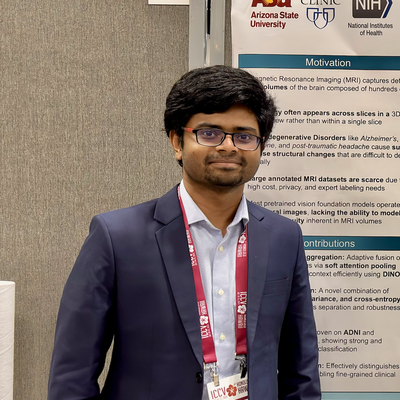
Fazle Rafsani is a Computer Science Ph.D. student at Arizona State University and a graduate research assistant at the ASU-Mayo Center for Innovative Imaging (AMCII). His research focuses on developing computer vision, deep learning, and generative modeling methods for medical image analysis—spanning supervised, weakly-supervised, self-supervised, and unsupervised lesion segmentation, detection, and classification. He also explores large language models and diffusion-based architectures to advance multimodal understanding and improve healthcare outcomes through AI. He serves as a reviewer for several leading conferences and journals in his field.
Education
PhD in Computer Science (ongoing)
Arizona State University
Master in Computer Science
Arizona State University
BSc in Computer Science and Engineering
Bangladesh University of Engineering and Technology (BUET)
Interests
Computer Vision
Deep Learning
Medical imaging
Large Models
Foundation Models
📰 Recent News
- Jun 2026: Presented my abstract for Headache Detection at *AHS 2026 Annual Meetings
- Mar 2026: LLMAgent4Bio got accepted in Breifings in Bioinformatics [impact factor 7.7]
- Feb 2026: AUCp got accepted in IEEE Transactions of Medical Imaging [impact factor 12.4]
- Oct 2025: DinoAtten3D presented at ICCV 2025 ADFM Workshop in Hawaii.
- Sep 2025: Paper got accepted in Nature Scietific Reports
- Aug 2025: AUCp paper submitted to IEEE TMI — introducing pseudo-AUC for unsupervised validation.
- Jul 2025: Awarded for the Graduate College Travel award
- Jul 2025: Awarded for the SCAI Travel Award to present my paper @ ICCV 2025
- May 2025: Awarded for the Gerald Farin Memorial Fellowship for outstanding academic performance and research in Computer Vision
- Apr 2025: Presented my abstract for Headache Classification using foundation models at AAN 2025 Annual Meeeting
- Feb 2025: Presented AnoFPDM at WACV 2025 application track.
- Aug 2024: AnoFPDM accepted at WACV 2025 for oral presentation.
Experience
Graduate Research Associate
Arizona State UniversityConducting research at the ASU-Mayo Center for Innovative Imaging, focusing on AI-driven medical imaging. Designed and implemented deep learning pipelines for segmentation, anomaly detection, and multi-modal brain MRI analysis. Authored and co-authored publications in leading venues, including WACV, ICCV, and Nature Scientific Reports.Graduate Teaching Associate
Arizona State UniversityServed as a Teaching Associate for CSE 110, a programming-based computer science course. Delivered lectures across four sections, engaging and managing a cohort of over 350 students.Software Engineer AI/ML
IQVIADeveloped Python-based web and ML frameworks with healthcare data for a recommendation system. Contributed to the “Next Best Actions” project, which won the Stevie Award in 2023.Software Engineer
ICT Cell BUETWorked as a full-stack software engineer. Built responsive and interactive system using Django, React.js integrated with PostgreSQL ensuring seamless user experience.
Education
PhD in Computer Science (ongoing)
Arizona State UniversityGPA: 4.0/4.0Master in Computer Science
Arizona State UniversityGPA: 4.0/4.0BSc in Computer Science and Engineering
Bangladesh University of Engineering and Technology (BUET)GPA: 3.54/4.0
📚 Research
Fazle Rafsani’s research centers on advancing foundation and generative models for medical image analysis, with a focus on improving automated diagnosis and interpretability in healthcare. As a Ph.D. student and research associate at the ASU-Mayo Center for Innovative Imaging (AMCII), his work integrates computer vision, deep learning, and multimodal learning to analyze complex medical imaging data such as MRI and CT scans.
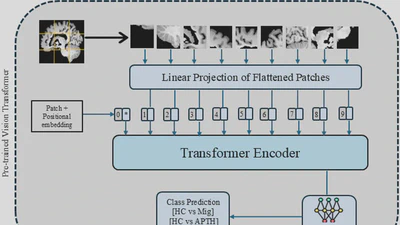
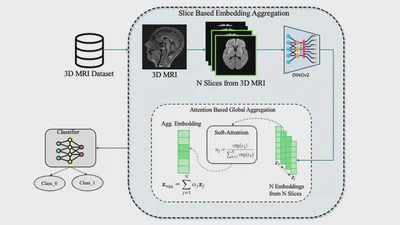
His contributions include developing DinoAtten3D, a slice-level attention aggregation framework that enhances 3D brain MRI anomaly classification, and AnoFPDM, a diffusion-based anomaly detection method that removes the need for pixel-level supervision. Through NIH- and DoD-funded projects, he applies foundation models like BioMedCLIP and MedSAM to tasks such as headache subtype prediction and thyroid nodule segmentation, emphasizing model interpretability through Grad-CAM-based biomarker visualization.
Rafsani’s research bridges cutting-edge vision transformers, contrastive learning, and diffusion models to create scalable, data-efficient solutions for neurological disorder diagnosis. His work has appeared in top venues including ICCV, IEEE TMI, and Nature Scientific Reports, reflecting both scientific innovation and translational impact toward clinically explainable AI systems in medical imaging.
Featured Publications
Recent Publications
(2026).
AUCp: Pseudo-AUC for Inference Model Selection with Unlabeled Validation Data in Abnormality Detection.
IEEE TMI.
(2026).
Large Language Model Agents for Biological Intelligence Across Genomics, Proteomics, Spatial Biology, and Biomedicine.
Brief. Bioinform..
(2025).
Leveraging multi-modal foundation model image encoders to enhance brain MRI-based headache classification.
Scientific Reports.
(2025).
DinoAtten3D: Slice-Level Attention Aggregation of DinoV2 for 3D Brain MRI Anomaly Classification.
In ICCV 2025 ADFM workshop.
(2024).
AnoFPDM: Anomaly Detection with Forward Process of Diffusion Models for Brain MRI.
In WACV 2025.
Recent & Upcoming Talks
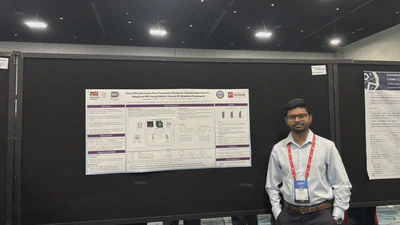
Presented abstract AHS 2026 annual meeting @ Orlando, FL
Presented my research work on APTH headache classification using DinoAtten3D framework
Fazle Rafsani
•
•
1 min read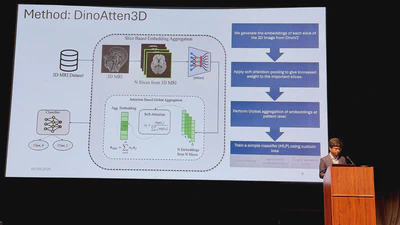
Presented DinoAtten3D in ICCV 2025 @ Honolulu, Hawaii
Presented my research work on Anomaly Detection using DinoV2 for Brain MRI
